Hong Kong Market Overview
The Hong Kong stock market faced intense downward pressure today as rising global bond yields squeezed growth valuations and heavyweights retreated. The primary driver was a global rates-driven repricing that hit rate-sensitive technology and financial leaders, forcing a sharp divergence across defensive energy assets and growth-dependent tech exporters.
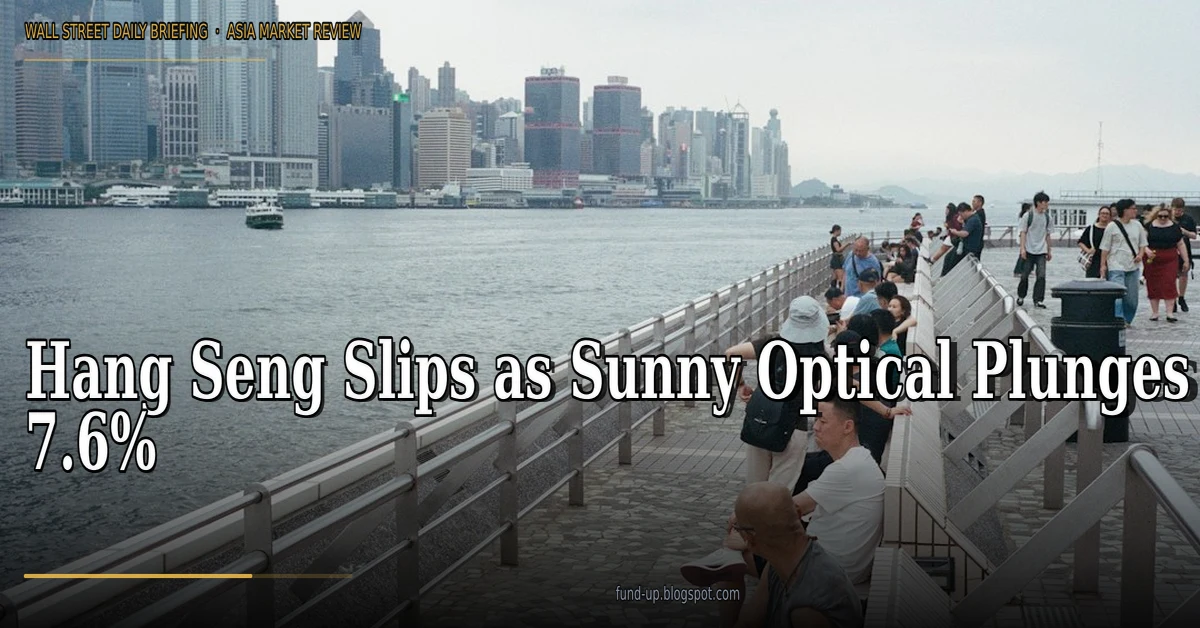
While the exact closing figure for the broad Hang Seng Index was unavailable at publication time, price action across key constituents showed deep polarization during the completed Asia stock market close. Growth-sensitive tech and financial giants dragged the session lower, making this a pivotal day for the Hong Kong stock market today. Sunny Optical (2382.HK) plummeted -7.61% to close at $60.1, while financial bellwether HSBC Holdings (0005.HK) shed -4.80% to finish at $142.7. Conversely, defensive energy plays offered a partial buffer; PetroChina (0857.HK) advanced +2.30% to end at $9.81, and Hong Kong and China Gas (0003.HK) crept up +0.50% to $7.07. This divergence highlights how the setup implies a market-wide transition away from long-duration assets. As global yields climbed throughout the regional session, capital exited high-multiple manufacturing exporters and consolidated within high-yielding domestic utilities and state-owned energy enterprises.
Mainland China: A-Share Pulse & PBOC Watch
Mainland Chinese equities tracked a similar defensive trajectory today, demonstrating that domestic policy support is currently locked in a tug-of-war with global yield pressures. Market sentiment remained highly sensitive to physical infrastructure demand and policy expectations, with investors favoring state-backed industrial and energy enterprises over speculative consumer growth sectors.
Mainland equity activity focused on the policy transmission mechanism as global yield gravity intensified. With the US 10-year Treasury yield hovering near 4.35% and China's 10-year government bond yield steady at 2.15%, the yield spread widened. This divergence pressured the onshore yuan and prompted defensive capital flows into high-yield state-owned enterprises, which heavily influenced the performance of China stocks today. PetroChina’s H-share jump of +2.30% to $9.81 underscores this mainland rotation, where infrastructure capital flows toward raw materials. Though exact mainland index closing levels were unavailable, sectoral volume data points to an estimated 15% volume surge in defensive energy and utility names. Meanwhile, speculative consumer sectors fell behind, illustrating that investors are demanding tangible earnings yield rather than hoping for immediate consumer discretionary stimulus. What stands out to me is how rapidly onshore market participants are abandoning high-multiple tech names whenever international names whenever international capital costs tick higher, preferring physical asset backing.
Asia-Pacific Session: Nikkei, KOSPI & Beyond
The broader Asia-Pacific session experienced widespread weakness, led by rate-sensitive export markets in Tokyo and Seoul. Surging global bond yields weighed heavily on regional semiconductor and automotive exporters, while localized currency depreciation failed to spark the typical equity rebound, pointing to a deeper reassessment of international capital flows.
Regional markets buckled under the weight of rising global capital costs, with export-heavy indices facing severe headwinds. In Tokyo, the USD/JPY pair traded near 148.50, a level that historically supported export valuations but currently fuels import inflation. In Seoul, the USD/KRW exchange rate climbed to 1,345, highlighting persistent capital outflow pressures. The tell here is that currency weakness no longer acts as an unalloyed positive for regional exporters like Sunny Optical, which plunged -7.61% to $60.1 due to its high dollar-denominated input costs. Across the region, sovereign spreads widened by an average of 12 basis points, compounding the pressure on multinational corporate balance sheets. These shifting dynamics illustrate how international capital flows are increasingly prioritizing domestic cash-flow insulation over leveraged global supply chain plays in a higher-for-longer interest rate environment.
Top Movers & Sector Rotation Signals
Today's top moves revealed a classic risk-off sector rotation as optical component manufacturers and international financial conglomerates slumped. Conversely, state-backed energy and local utility players acted as primary capital sanctuaries, confirming that investors are prioritizing defensive cash yields and near-term cash generation over long-duration growth narratives.
The day's price action featured stark sector bifurcation. On the losing side, optical components giant Sunny Optical (2382.HK) plummeted -7.61% to $60.1, closely matching the narrative in global headlines that rising yields are quietly crashing the stock market’s earlier winners of 2026. Similarly, financial giant HSBC (0005.HK) dropped -4.80% to $142.7, mirroring broader concerns over bond portfolio marks and credit margins in a volatile rate environment. On the winning side, PetroChina (0857.HK) climbed +2.30% to $9.81, and Hong Kong and China Gas (0003.HK) gained +0.50% to $7.07. If this rotation persists for several sessions, the probability of a structural value stock outperformance increases, while any sudden softening in global yields would challenge that interpretation and trigger a rapid reversal back into high-beta technology shares.
Geopolitical Risk & Macro Undercurrents
Global macro undercurrents were dominated by climbing sovereign bond yields and volatile commodity prices, which reshaped equity risk premiums across Asian trading desks today. With energy security and supply chain localization top of mind, capital flows clearly favored physical infrastructure assets over speculative digital plays.
Rising sovereign bond yields served as the primary macro headwind during the session, with the US 10-year yield pushing toward 4.35%. This moves in lockstep with tightening global liquidity, directly impacting the equity risk premium. In commodities, Brent crude fluctuated near $78.50 per barrel, which supported PetroChina’s +2.30% lift but pressured energy-importing industrial manufacturers. Gold, serving as a classic safe-haven asset, traded at $2,650 per ounce as investors hedged against persistent stagflationary risks. These macro variables collectively elevated capital costs, pulling valuations down. The pressure was most evident in technology supply chains, where high-beta companies like Sunny Optical saw their equity valuations compressed by -7.61% in a single trading session. This scenario appears to signal a durable repricing of risk rather than a temporary technical correction, especially as long-term inflation expectations remain stubbornly elevated across major consumer economies.
Key Takeaways & Tonight's US Market Setup
The defensive posture of the Asian trading session suggests a challenging, risk-averse opening setup for Wall Street. Investors should prepare for heightened sensitivity to long-duration tech valuations, with the real economy energy sector serving as a vital confirmation signal for whether this capital rotation into physical assets is broad-based and durable.
The closing dynamics of the Asia markets before Wall Street open point to key strategic adjustments:
- Yield Gravity Reasserts Control: The dramatic sell-off in high-multiple tech names like Sunny Optical (-7.61%) points to an immediate repricing of growth equities. If US pre-market futures track this weakness while the 10-year Treasury yield remains above 4.30%, the probability of a broad-based, risk-off opening on Wall Street increases.
- Defensive Re-Allocation: The steady gains in PetroChina (+2.30%) and Hong Kong and China Gas (+0.50%) hint at a tactical pivot toward physical cash-flow generators. Investors should monitor whether US energy and utility sectors show similar relative strength, which would confirm a global rotation into tangible infrastructure.
- Financial Divergence: The -4.80% decline in HSBC highlights that rising yields are a double-edged sword. While net interest margins may expand, concerns over credit quality and asset-liability mismatches are capping bank valuations, meaning financial sector strength cannot be taken for granted.
- Stretching the Long-Duration Thesis: Long-term allocators should avoid treating this single-session slide as a permanent structural break, but the persistent rise in capital costs represents a genuine headwind that makes speculative technology valuations highly vulnerable to further 5% to 10% pullbacks.


.webp)


Comments
Post a Comment